


On July 1, 2026, one of America's largest retail brokers switched on its own blockchain. Two weeks later, Robinhood Chain ranks among the top five networks by DEX volume, with $3.1 billion traded in its first week. For anyone watching where traditional finance and crypto are heading, this launch is the clearest signal yet: they are converging on the same rails.
Here's what Robinhood Chain actually is, how it works, and why it matters far beyond one company's product line.
What Is Robinhood Chain?
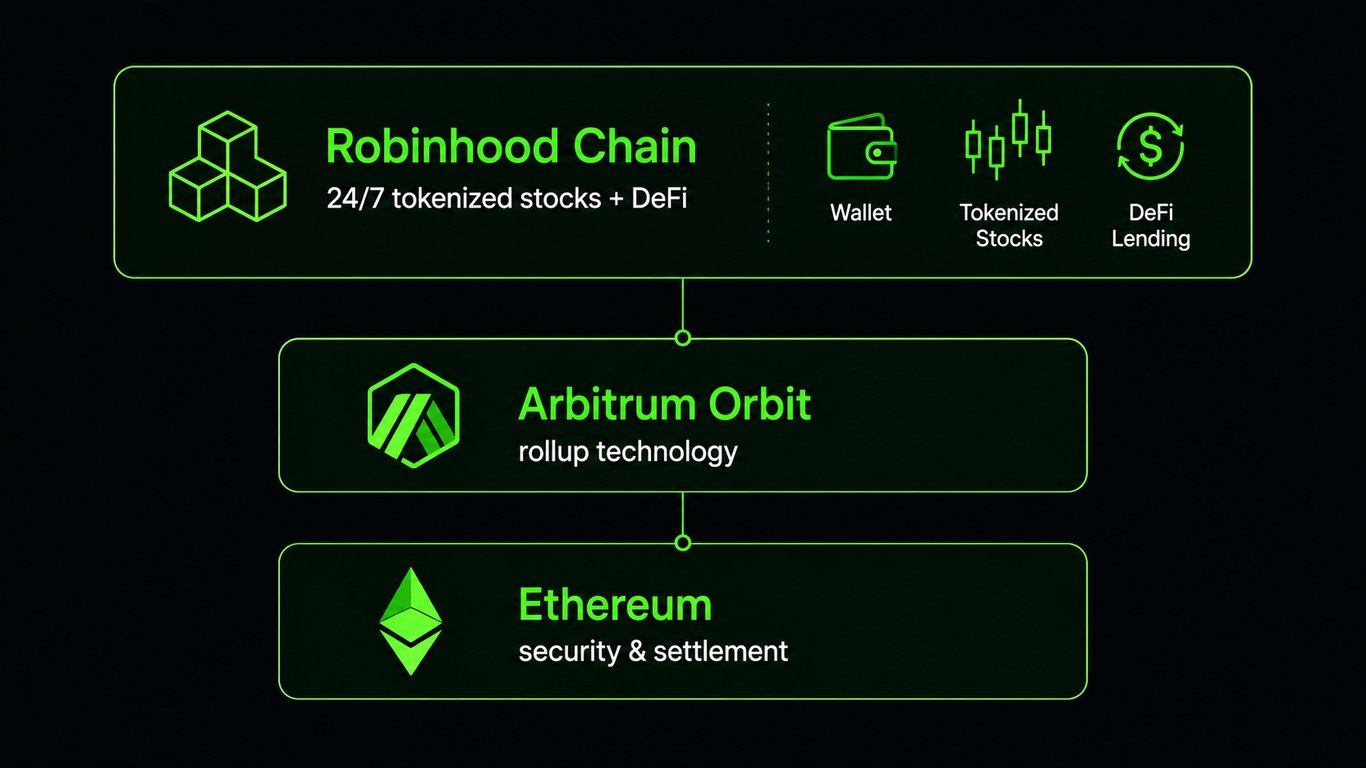
Robinhood Chain is an Ethereum Layer 2 network built on Arbitrum's Orbit stack. In plain terms: transactions run on Robinhood's own fast, low-cost network, while the records settle to Ethereum, which secures the chain's history. If you've used any modern L2, the mechanics will feel familiar.
Three design choices define it. The chain is permissionless – any developer can deploy contracts without Robinhood's approval. It is EVM-compatible – every Ethereum wallet, tool, and smart contract works out of the box. And it is purpose-built for real-world assets, with Chainlink as the official price oracle, BitGo on custody, and fast block times via Alchemy infrastructure.
One detail worth noting: there is no chain token. Gas is paid in ETH, and 10% of the network's fees flow to the Arbitrum ecosystem, with 8% going directly to the ARB treasury. Robinhood is betting the value accrues to its core business, not to a new coin.
Stock Tokens: The Product the Chain Was Built Around
The flagship asset class is Stock Tokens – on-chain versions of 95 equities, including NVDA, AAPL, and GOOG, that trade 24 hours a day, 7 days a week. No exchange sessions, no waiting for Monday.
A Stock Token gives you price exposure to the underlying equity in a token that behaves like any other crypto asset. You can hold it in a self-custody wallet, transfer it, trade it at 3 a.m. on a Sunday – and, most importantly, plug it into DeFi. Morpho's lending markets on the chain accept Stock Tokens as loan collateral, meaning a holder can borrow stablecoins against a tokenized NVDA position with no paperwork.
What Stock Tokens do not give you is shareholder status. Holders don't vote, and corporate rights stay with the issuance structure. These are exposure instruments, not shares.
The sharpest irony of the launch: Stock Tokens are available in more than 120 countries, but not in the United States, where the regulatory line between a compliant token and an unregistered security remains undrawn. An American broker built a global product that its own home market can't touch yet.
The First Two Weeks in Numbers
The launch produced statistics the whole industry is now measuring against:
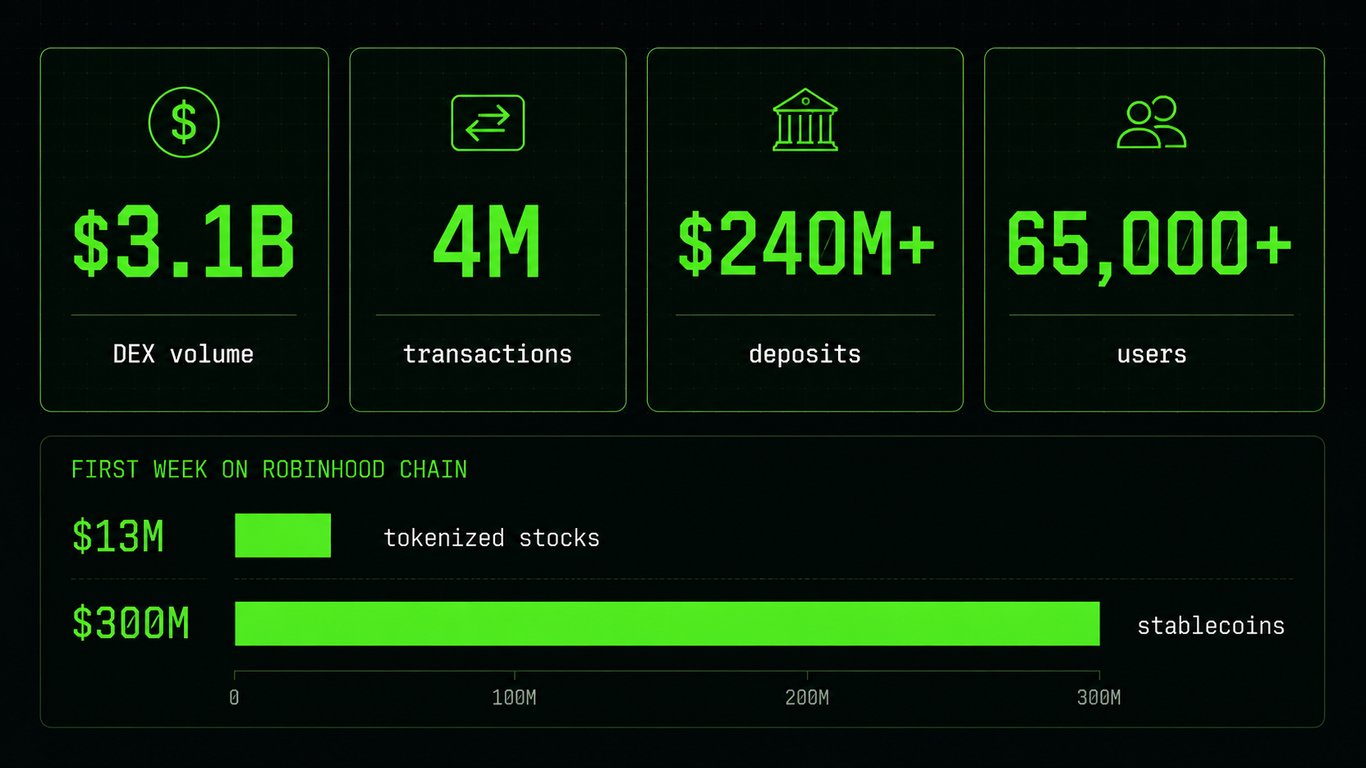
— $3.1 billion in DEX volume in week one, placing the chain in the top five networks by decentralized trading activity
— Roughly 4 million transactions and over $240 million in deposits within days
— 65,000+ users holding assets on the network
— Day one alone: $570 million in volume against just $21.68 million of liquidity
And here's the twist. The chain was built for stocks, but memecoins took over the early volume. Users hold about $13 million in tokenized equities versus $300 million in stablecoins. The crowd arrived instantly; it just wasn't the crowd the mission statement described. History suggests Robinhood won't mind: Coinbase's Base started exactly the same way before maturing into a broader economy.
Why This Matters for Web3
Distribution is the real story. Every previous chain had to convince users to download a wallet, back up a seed phrase, and bridge funds. Robinhood ships its chain inside an app tens of millions of people already carry. One tap from a familiar consumer interface to an on-chain economy, that's a head start no organic launch can match.
The bigger pattern is hard to miss. Coinbase runs Base. Stripe backs Tempo. Now a major broker runs its own L2. Consumer giants are no longer renting neutral rails, they're building their own, and bringing their audiences with them.
For the betting world, the same logic has already played out. Dexsport was built on this exact principle from day one: users connect a crypto wallet and play directly on-chain, with deposits in USDT, BTC, ETH, $DESU and other assets – no bank cards, no waiting on payment processors. What Robinhood is now proving to Wall Street, Web3-native platforms have been demonstrating in practice: when the account is your own wallet, speed and control stop being features and become the default.
The Open Questions
Three things will decide what Robinhood Chain becomes. Control: the sequencer, the flagship assets, and the main interface all run through one regulated company – decentralized at exactly one layer. Liquidity: 24/7 stock trading is only as real as its depth, and early depth in equities was thin next to the speculative noise. And law: the US geofence, token classification, and the first serious corporate action on tokenized equities are all uncharted territory.
The metrics worth watching are the boring ones, stock-token volume as a share of activity, collateral composition in lending markets, and whether deposits stay once launch incentives step down. Those numbers, not the keynote, will show whether this was a foundation or a fireworks show.
Either way, the significance is settled. A top broker building a public blockchain around real-world assets, and filling it with first-tier DeFi on day one, means the old question of whether traditional finance would ever arrive on-chain is closed. It has arrived. What's left is the practical part: watching it learn to work.


 Coinmarketcap
 CoinGecko
 DEXTools